Gaming has evolved from primitive graphics and sounds to incredibly realistic mobile games.
The technology behind gaming has shrunk in size while growing in power.
Gaming has expanded beyond entertainment to include esports and social connections.
The future of gaming may offer AAA titles readily available on mobile devices.
Gamers will have access to high-quality gaming experiences anytime, anywhere.
These are the graphics of yesteryear. Photo by Francesco Ungaro, please support by following @pexel.com
Unplug & Blow
Ah, the good old days of gaming, when the graphics were so pixelated you could count each square on the screen, and the most immersive sound was a repetitive ‘beep-boop’. Yes, we’re talking about the era of Atari, where a stick figure shooting at blocky asteroids was the height of technological advancement. Fast forward a bit, and you’ve got the Sega and Nintendo NES – where the ritual of blowing into the cartridge was a sacred act that somehow (by pure magic, we assume) made the games work again.
But let’s not forget the countless hours spent wiggling the cords, smacking the side of the TV, and performing a rain dance in hopes of getting that darn game to load. And who could ignore the classic ‘screen freeze’ followed by the universal gamer’s shriek of despair? Ah, memories.
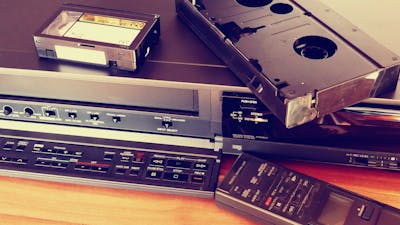
From rectangle to whatever this shape is. Photo by JESHOOTS, please support by following @pexel.com
Now, hold onto your joysticks, because we’ve catapulted from those Stone Age antics to having sleek, shiny games on our mobile devices that look so real you might try to swipe a health potion off the screen. The computing power of these tiny chips is mind-boggling – they’re getting larger in capacity but shrinking in size like a digital Ant-Man.
And the impact? It’s gone way beyond just entertainment. Games have become training grounds for lightning-fast reflexes and strategic thinking, even landing some folks college scholarships for their esports skills. Online worlds have fostered friendships and rivalries that bridge continents, proving that a good game can break down all sorts of barriers.
The future? Oh, it’s looking as bright as the neon lights in a retro arcade. Imagine this: AAA titles, those big-budget, high-quality games that usually require a console the size of a small car, will be available at the tap of a screen. That’s right, no more discs, no more downloads that take longer than a trip to Mars, just pure, unadulterated gaming bliss at your fingertips.
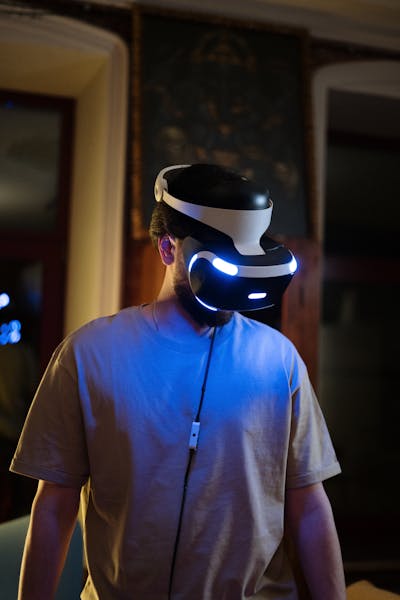
VR headsets are in the market to become smaller. Photo by cottonbro studio, please support by following @pexel.com
So, what does this mean for us, the noble gamers? It means our thumbs are about to become the most powerful tools in the universe. It means we’ll be gaming on the bus, in line at the grocery store, and – let’s be honest – probably during that boring meeting at work (not that we endorse such behavior, of course).
In conclusion, from the beep-boop to the tap-tap, the gaming world has evolved in ways that would make Darwin drop his monocle. So, here’s to the gamers who’ve survived the pixel wars, the cartridge blowers, the cord wigglers, and the screen freezers. The future is yours, and it’s just a tap away. Game on, world, game on!
Enjoy what you read? Why not consider subscribing for more?
Life was less convenient but more active: Entertainment and information gathering involved physical activity and social interaction.
Resourcefulness and ingenuity were essential: People had to rely on their knowledge and physical resources to complete tasks, like using libraries and manual copying.
Social interaction may have been more prevalent: Without the internet, people may have interacted more face-to-face within their communities.
The charm of a simpler time: The passage emphasizes the sense of nostalgia and fondness for a less technologically dependent era.
The days when there were villages to help raise children. Photo by Caleb Oquendo, please support by following @pexel.com
Ah, the pre-internet era, a time when ‘surfing’ meant catching waves at the beach, not browsing the web. Let’s take a whimsical look back at the good ol’ days before the digital takeover.
Remember when ‘running around’ was our cardio? We didn’t need fancy fitness trackers; our sweat-soaked shirts were proof enough of our exertion. And those doorbells weren’t going to ring themselves! We were the original ‘notification alerts’ for our friends, and the only ‘ghosting’ was when someone pretended not to be home.
Libraries were our Google, and boy was the search function different. You’d pull out a drawer full of cards (the ‘Card Catalogue’) and embark on a treasure hunt for knowledge. Dewey Decimal System? More like Dewey Deci-‘thrill’ System! And let’s not forget the photocopying machine, which was basically the ‘screenshot’ of its time.
Technology of yesteryear. Photo by Anthony, please support by following @pexel.com
Homework was an adventure in itself. You couldn’t just copy-paste from Wikipedia; you had to actually understand the material (shocking, I know). And if you needed help? You’d consult the wise old ‘Encyclopedia’—the only ‘Wiki’ we knew.
So, here’s to the days of innocence and simplicity, where the biggest worry was returning a VHS tape to Blockbuster on time. Life before the internet may have been less convenient, but it sure had its charming quirks. Now, excuse us while we go ‘rewind’ our memories a bit more. Be kind, rewind!
Quick note: if you’re viewing this via email, come to the site for better viewing. Enjoy!
It’s time to check out what happening on scriptingthewhy.com again. Photo by Porapak Apichodilok, please support by following @pexel.com
Here’s a scenario, picture yourself sitting at your computer, thirst-scrolling Instagram on your phone, putting off responding back to emails, handling tasks, and receiving those juicy dopamine hits. You know, just another day in the office for you.
While emails are piling up, notifications on your phone and computer are going off, the watercooler farts a water bubble, and your smartwatch is telling you to get up and start moving or you’ll be one step closer to God’s waiting room. I’m not talking about Florida.
During your quest to come upon the perfect thirst pic so you can quickly run to the restroom and get a handle on your developing situation, have you ever stopped to question “how are all of these devices connected?”
You say no? You wouldn’t be alone in that regard; many people just use devices and don’t really give a second thought as to how they work. We just use them and take them for what they are and their purpose in our daily lives.
However, it’s time to answer the question you didn’t ask because well, I’m a scriptwriter and somehow through the powers that be I find this enjoyable to entertain and inform you so without stealing candy from a baby, I bequeath to you the connection between all of the devices we use throughout our daily lives and what would life be like if we didn’t have them.
Which I could tell you right now, if we didn’t have them then you would still be thirst-scrolling, the personals section in the newspaper was Instagram back in the day. I’m not proud of that knowledge.
I’m not liking that photo again, that was Eric with an a. Photo by Andrea Piacquadio, please support by following @pexel.com
Insta-Connections
This connection, what is it called? You may have heard of it in passing or never at all. The term Internet of Things, better known as IoT, broadly means the collective network of connected devices and the technology that facilitates communication between devices and the cloud.
These devices could range from ordinary household objects to sophisticated industrial tools. The phrase is used to describe the ever-expanding network of smart devices used by sometimes not-so-smart people that connect to the internet.
However, devices that you wouldn’t typically expect to connect to the internet, for example, laptops and smartphones are not typically described as IoT devices. Why? Because anything that requires human interaction or control is not considered a part of IoT.
The concept first IoT emerged as a serious proposition in the 1980s – 1990s, which was pretty much a wild time to be alive. The earliest projects included a connected vending machine, but progress was hindered by early chips being cumbersome and objects struggling to communicate with each other effectively. If you have been in a struggling relationship, you have an idea of what this feels like.
I wonder if the vending machines had the same experience they did in Maximum Overdrive, you know, attempting to hand out people’s expiration dates with Pepsi product placement. That symbolism hits way too hard.
Tom: You know the sensor can in other directions aside from just up and down. Sarah: I know…it’s just. Tom: You miss him, don’t you? Photo by ThisIsEngineering, please support by following @pexel.com
IoT Connecting Us
Z-Daddy, what do we use that is connected to IoT? Again, pending robot uprise experience inbound. Here’s your list of things to look at and jokingly say to yourself “there’s no way that could speed up my expiration”; dishwashers, refrigerators, smart TVs, smartphones, cars and trucks, heating and cooling systems, fitness machines, and trackers are some examples of IoT.
Most of these products you have experienced personally but keep in mind, while your chances of receiving your expiration date by one of these items are low, it’s never zero.
Generally, IoT is most abundant in manufacturing, transportation, and utility organizations, making use of sensors and other IoT moreover, it has also found use cases for organizations within such as water resource monitoring in agriculture, healthcare, infrastructure, and home automation industries, leading some organizations toward digital transformation. Ja (Yes), we’re pretty much one Elon tweet away.
While the idea of IoT has been in existence for a long time, a collection of recent advances in a number of different technologies has made it practical. Access to low-cost, low-power sensor technology, connectivity, cloud computing platforms, machine learning, and analytics. Imagine, all of this taking place while you spend your days thirst-scrolling.
Enjoy the read so far? Why don’t you consider subscribing so you can keep up to date?
Choose your addiction from the semi, mid, or crippling. Photo by Pixabay, please support by following @pexel.com
93 and Lonely
Now I can hear you yelling at some of the items listed earlier, saying “THEY TOOK OUR JOBS!” You didn’t know but you were going to give the job away anyway. I would take a self-driving lawn mower than have to go out and mow my lawn in the hot sun any day.
Having my 93-year-old neighbor staring at me from her living room window while I’m all sweaty working, I mean she’s nice and offers a glass of lemonade and cookies, but Z-Daddy can’t be that daddy. Although… she has Medicare and might have a decent life policy so I may be able to make it a short-term situation. Older people need love too, don’t judge.
Now back to sticking it to IoT and not my neighbor, there is a massive market for intelligent electronics, and over the past few years, IoT has become one of the most important technologies of the 21st century. And years ago, we thought conjuring fire was a big deal.
Now that we can connect everyday objects, IoT enables companies to automate processes and reduce labor costs. A quick word to the wise, if your job is simple enough for a computer to do it, you might want to start looking elsewhere for work.
It also cuts down on waste and improves service delivery, making it less expensive to manufacture and deliver goods, as well offer transparency in customer transactions. Again, these are all keywords for you being replaceable if you haven’t caught on by now.
In short, technology is making life great by making things easier, the downside is it’s making us lazier.
Handling a situation in restroom, be back in five. Photo by Pixabay, please support by following @pexel.com
Developing Years Behind
Do you want to know if you can hop into the field of IoT and help technology grow? You don’t want to go to school for a four-year degree and live off ramen and depression or have to meet someone in the alleyway to provide something strange for some change.
I have some good news; you don’t have to. Well, you still might have to meet someone in the alleyway if you need the change or a source of inspiration but for the most part, you don’t have to spend your best years trying to get a degree.
There are many jobs to select and since technology is growing like your developing restroom situation mentioned earlier, going to school would actually see you behind instead of ahead. Saw what I did there? You could detour to other avenues of learning like completing online courses or attending meetups, just stay away from people wanting to link up in alleyways.
This might not be Tinder but with writing like this, I don’t feel lonely. Photo by Marcus Aurelius, please support by following @pexel.com
Made it this far and found this to be entertaining? Then a big thanks to you and please show your support by cracking a like, sharing this with whomever, scripting a comment, or plug-in to follow.
Would like to give sincere thanksto current followers and subscribers, your support and actions mean a lot and has a play in the creation of each script.
Do you feel like there’s something I may have missed about the Internet of Things? Script a comment about it below.