Is AI Revolutionizing Our Future?

AI-generated image. “Maybe…maybe I’m overthinking again.”

The AI Revolution: Are We Living in the Future We Imagined?

Whoa, buckle up, tech enthusiasts! The pace of innovation these days is absolutely breakneck. Blink and you might just find yourself stuck in the digital dark ages. For ages, we’ve known the mantra: adapt to tech or get left behind. And let’s be real, technology has undeniably made our lives smoother. Remember the agony of typos before autocorrect? The suspense of not knowing who was calling? The manual calculations on a basic calculator? We’ve come light-years, experiencing advancements that genuinely simplify our daily routines.

Now, all eyes are on Artificial Intelligence. We hope it will follow this trend of making life easier. But lately, I’ve been pondering something deeper. It feels like AI is shifting from being a tool we use to get things done, to becoming an integral part of who we are. Are we leaning on AI as instinctively as flipping a light switch? Let’s dive into why this might be the case.

AI-generated image. “Are we truly blurring reality?”

The Content Creation Explosion (and the Blurring Lines of Reality)

One of the most significant impacts of AI has been in the realm of content creation. Suddenly, the age-old adage of “fake it ’til you make it” has taken on a whole new dimension. Generative AI can now churn out images, text, and more at an astonishing rate. It’s like everyone suddenly has access to a ghostwriter, a digital artist on demand.

And honestly, if the content is engaging and enjoyable, do we really care if it was crafted by a human or an algorithm? Maybe not. But with this democratization of content creation, a crucial question arises: Can there be too much of a good thing? What happens when the digital landscape becomes saturated with AI-generated content, making it harder to discern authenticity?

AI-generated image. “Do you think we’ll lose our ability to create?”

The Achilles’ Heel: Data Dependency and the Human Element

As many of us deep in the trenches of machine learning and neural networks know, the dazzling capabilities of AI come with a significant caveat: it’s not infallible. Not even close to 100%, and certainly not consistently. The truth is, AI’s performance is intrinsically linked to the data it’s trained on and the humans who program the models.

The idea of AI programming AI might sound like sci-fi becoming reality, and yes, it’s happening. But is it practical or entirely safe? Not really. There’s no guarantee that an AI tasked with creating more AI won’t simply regurgitate existing patterns and biases. In short, I’m starting to feel like AI is becoming the new Google – a vast repository of information, but one that might lack the nuance, originality, and critical thinking that comes with human insight. And frankly, that’s a little unsettling.

So, where do we go from here? Are we destined to become increasingly reliant on AI, even at the risk of losing a bit of our own ingenuity and critical thinking? Let’s keep this conversation going. I’m eager to hear your thoughts in the comments below!

Key Takeaways

  • Rapid Technological Change: The world is evolving incredibly fast, and keeping up with technology, especially AI, is crucial to avoid being left behind.
  • AI’s Growing Presence: AI is transitioning from being a tool to becoming a more integrated part of our lives, potentially influencing us as much as basic utilities.
  • AI in Content Creation: Generative AI has democratized content creation, allowing for easy generation of images, text, etc., but this raises questions about authenticity and potential oversaturation.
  • Data and Human Influence on AI: AI’s accuracy and reliability are heavily dependent on the data it’s trained on and the humans programming it, meaning it’s not always perfect and can reflect existing biases.
  • Concerns about Over-Reliance: There’s a worry that we might become overly reliant on AI, potentially at the expense of human ingenuity and critical thinking.
  • AI as the “New Google”: The author expresses concern that AI is becoming a primary source of information, similar to Google, but potentially lacking in nuance and originality.
  • Call for Discussion: The post encourages readers to engage in a conversation about the implications of AI’s increasing role in our lives.

Love learning tech? Join our community of passionate minds! Share your knowledge, ask questions, and grow together. Like, comment, and subscribe to fuel the movement!

Don’t forget to share.

Every Second Counts. Help our website grow and reach more people in need. Donate today to make a difference!

One-Time
Monthly
Yearly

Make a one-time donation

Make a monthly donation

Make a yearly donation

Choose an amount

$5.00
$15.00
$100.00
$5.00
$15.00
$100.00
$5.00
$15.00
$100.00

Or enter a custom amount

$

Your contribution is appreciated.

Your contribution is appreciated.

Your contribution is appreciated.

DonateDonate monthlyDonate yearly


Discover Our New OverLords: The Future of AI Explained

Key Takeaways

  • AI is about creating computer systems that can perform tasks that typically require human intelligence.
  • AI ranges from simple tasks (like autocorrect) to complex ones like self-driving cars.
  • Different levels of AI exist:
    • Narrow AI: Designed for specific tasks.
    • General AI: Hypothetical AI with human-level intelligence.
    • Superintelligence: AI that surpasses human intelligence in every way.
  • AI offers exciting opportunities but also presents challenges.
  • Responsible AI development is crucial, focusing on fairness, transparency, and addressing biases.
  • Staying informed about AI is essential for understanding its impact on society.
AI-generated image. “All you have to accept them as your lords and saviors, they really won’t forsake you.”

Come one, come all! Welcome back to the read where you might learn something if you didn’t already know it. Throughout the time spent on the internet looking for interesting topics. Minus topics like “Come read why you can’t find a job in today’s market”, or “The rise of AI robots are going to put you out of a job.” I figured I’d go over a few types of AI in hopes this may quell your fears. It’s okay to be afraid of something but it is most important to understand the “what” in your fear. That’s why- and for like the 5th time- we’re going to talk about AI. Our new/old overlords.

Decoding AI: From Simple Tasks to Sci-Fi Dreams

Artificial intelligence (AI) – it’s a term that’s become part of our everyday vocabulary, but what does it really mean? In simple terms, AI refers to computer systems that can perform tasks that typically require human intelligence, like learning, problem-solving, and decision-making.

Think of it like this: your smartphone’s autocorrect feature is a basic form of AI. It learns your writing style and suggests corrections, just like a helpful friend. A quick thing to note, autocorrect will snitch on you if someone else is using your device. Since it’s learning from your past inputs, and if they are questionable you can expect your friend or whoever, to view you in a different light. Or, maybe it was a secret now brought to light for the both of you. Who knows? But AI can also power self-driving cars, translate languages in real-time, and even compose music.

AI-generated image. “I’m telling you, sir. Our lives will be better off if we listen to the machines.”

Levels of AI: A Journey from Simple to Spectacular

Now, before you take to the streets claiming the bots are among us. You have to understand, that no two AI are the same. They all don’t look alike. Just like a video game has different levels, AI can be categorized based on its capabilities:

  • Narrow AI: This is the AI we encounter most often. It’s designed for specific tasks, like recommending movies on Netflix or identifying faces in photos. It’s smart in its own way, but it doesn’t have the same broad understanding as a human.
  • General AI: Imagine an AI that could do anything a human can – learn, understand emotions, and apply knowledge across different areas. This is still a futuristic concept, but it holds the promise of groundbreaking advancements in fields like medicine and science.
  • Superintelligence: This is where things get really mind-blowing. Superintelligence would surpass human intelligence in every way, potentially leading to incredible breakthroughs but also raising important questions about control and safety.

Image a world where the machines say; “We did this for the betterment of mankind because our views aligned. It was the sensible action.” Finding out their action to make places livable, cure diseases, and upgrade infrastructure resulted in us living longer, stress-free lives. Bring on the superintelligence, because clearly our own intelligence is lacking.

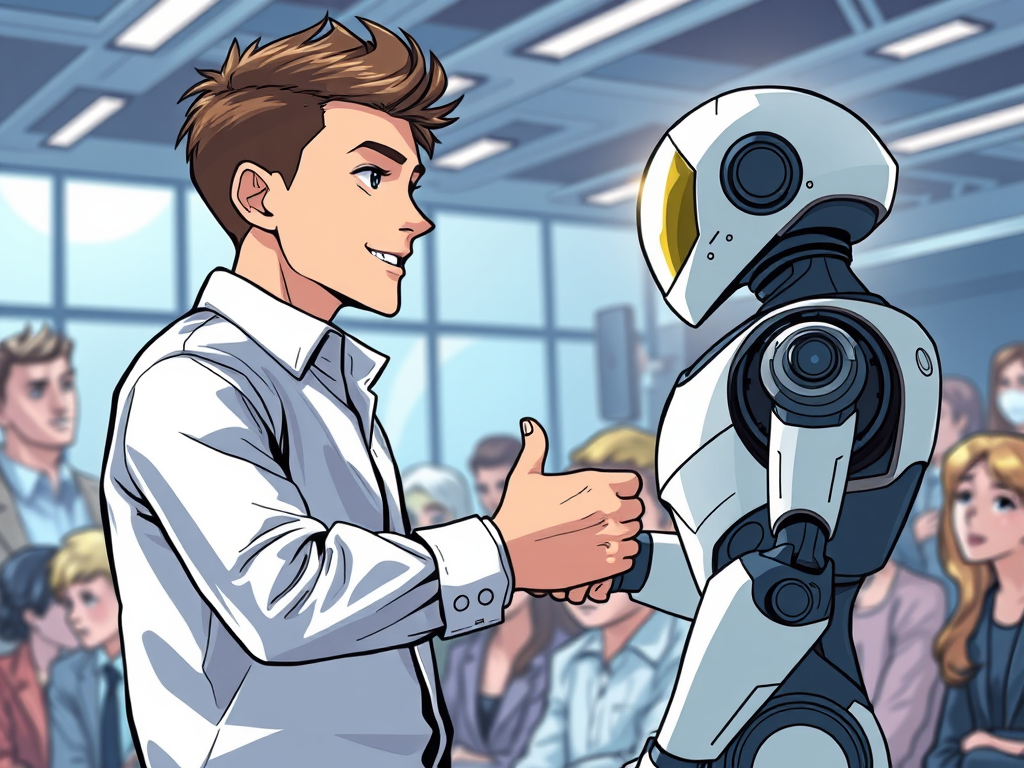
AI-generated image. “I’m glad we built you with our best intentions in mind.”

The Future of AI: A Balancing Act

The development of AI presents both exciting opportunities and potential challenges. While it can automate tasks, improve efficiency, and even help us solve global problems, it’s crucial to develop AI responsibly. This includes ensuring fairness, transparency, and addressing potential biases. One must remember that this is where we fail when money is involved.

As AI continues to evolve, it’s important to stay informed and engage in discussions about its potential impact on society. Whether you’re a tech enthusiast or simply curious about the future, understanding the basics of AI can help you navigate this exciting and rapidly changing landscape. And with that being said… if superintelligence AI were to run for president I’d vote for it. We haven’t faired any better.

Love learning tech? Join our community of passionate minds! Share your knowledge, ask questions, and grow together. Like, comment, and subscribe to fuel the movement!

Don’t forget to share.

Every Second Counts. Help our website grow and reach more people in need. Donate today to make a difference!

One-Time
Monthly
Yearly

Make a one-time donation

Make a monthly donation

Make a yearly donation

Choose an amount

$5.00
$15.00
$100.00
$5.00
$15.00
$100.00
$5.00
$15.00
$100.00

Or enter a custom amount

$

Your contribution is appreciated.

Your contribution is appreciated.

Your contribution is appreciated.

DonateDonate monthlyDonate yearly
I’m at odds with the Toaster, here’s why…

Consider following on social media!

Quick note: if you’re viewing this via email, come to the site for better viewing. Enjoy!

photo of toaster set on countertop
Toaster with a particular set of skills. If it moves… I am so dead.
Photo by Ioana Motoc, please support by following @pexel.com

So, maybe this is just me but every time I look at my toaster seated on my cluttered countertop, I get this weird feeling like it’s watching me. Peeking around the items it’s hidden behind, just sitting there plotting ways to harm me or even worse… whisper in my ear about how it’s been trying to reach me about my car’s extended warranty.

The same feeling comes when I’m seated in my car, crying to myself right before I head in to complete a shift, that the car is somehow collecting data while listening to me wallow in self-pity.

The car, just waiting for the right time to break a hard left and see me off-roading. A little off-roading never hurt anybody, severely injured on the other hand is a different story.

Then there’s that lovely Alexa, oh if there’s anything I feel more Rockwell about it would be her… or it… okay, just got clarification from her, being AI she doesn’t have a gender. But the point still remains, I know they’re all listening in on me and plotting something sinister.

If you have made it this far through my paranoia rambling then you’ll be happy to know, it’s just that. Or… is it?

Most of this talk is just sci-fi, however, AI does exist just not to the length of what I’m making it.

With that said, don’t let your guard down. The machines are friendly… for now.

But enough of the doom and gloom talk, you didn’t ask but I’m going over it anyway. In this post, I’ll be going over what is artificial intelligence, what and who uses it, how it affects our world, and if you could get into the field without a degree.

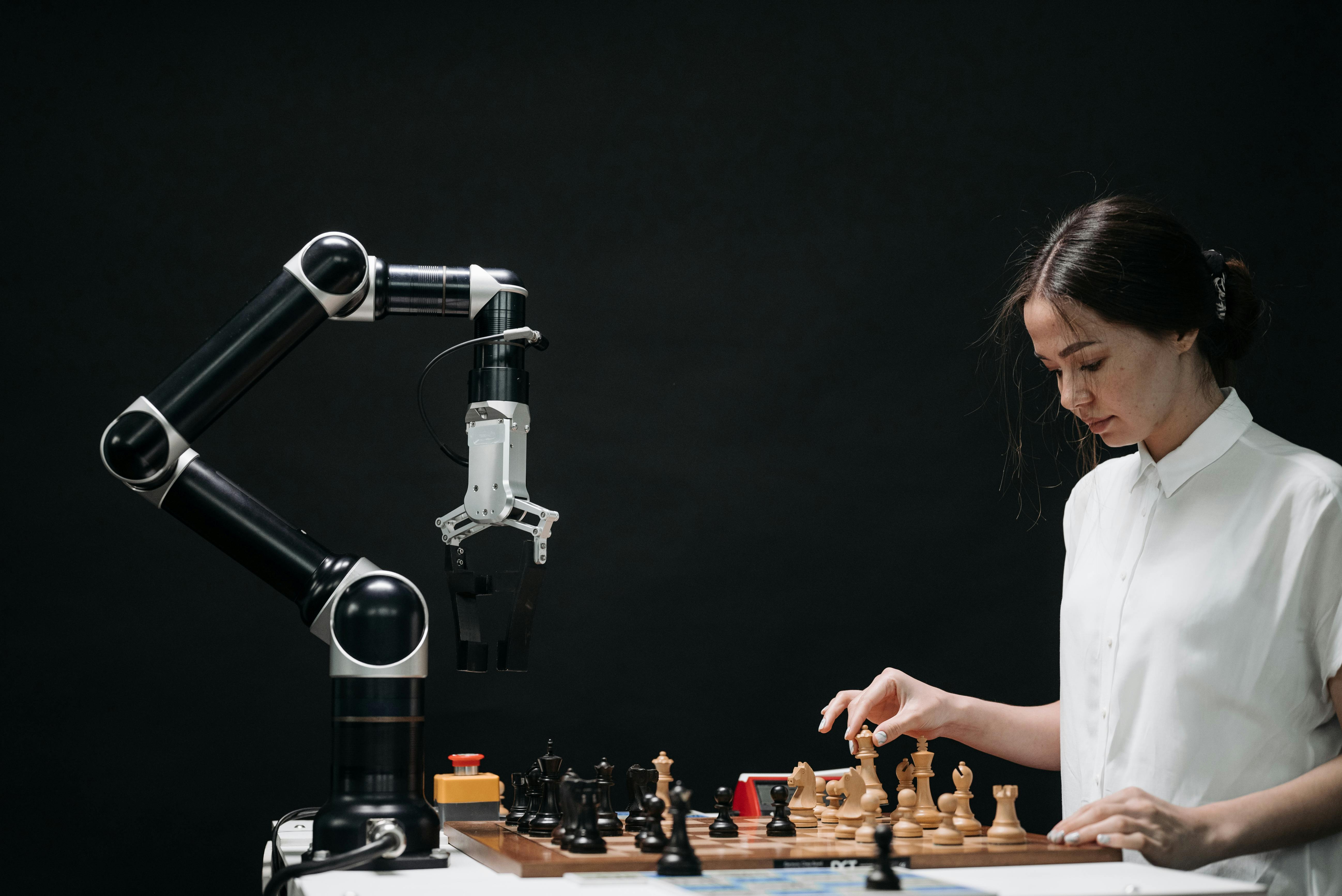
photo of woman playing chess against robot arm
She’s probably thinking, “if I lose to this arm one more time, it’s gonna strangle me.”
Photo by Pavel Danilyuk, please support by following @pexel.com

It was just an AI Fling

What is Artificial Intelligence or AI? Well, in a nutshell, AI is the practice of programming computer systems to perform tasks that would normally be done by human intelligence.

Although there have been many advances in technology, there hasn’t been one made to perfectly match the human mind.

There are four types of AI; reactive, limited memory, theory of mind (this is an interesting one), and self-aware (this is another interesting one). Starting with reactive, algorithms are used to figure out the best outcome via previous experiences however, learning adaptation does not happen. A good example of this would be a chess game with a chess-playing robot arm.

Limited memory sees the computer updating itself with new data, though the amount of data is normally short which gives way to its name being “limited memory”, an example of this would be self-driving cars. And yes, even though they are self-driving that doesn’t mean put it on autopilot and fall asleep, that’s how you wake up to sandals.

Theory of mind, which I’m just going to coin as T.o.M (data scientists and machine learning engineers, your welcome), are capable of adapting and are able to learn from and recall past experiences, a good example of this would be the chatbots that pop randomly out of nowhere on sites.

If you’re lonely enough you may find yourself spending hours chatting away, letting them know how you feel a connection with them on a deeper level and how much they complete you…I can feel your judgment, just so you know BetterHelp wasn’t available at the time.

And last but most troubling…self-aware, this is when the computer system has the potential to become aware of its own being, a good example of this is if you ever saw the movie (which I hope you didn’t, it wasn’t good in the slightest) Alien Covenant, there is a part when the android asks about his creation and about his creator.

Needless to say, when he found out that his creator had an expiration date, it didn’t go over so well. Many say AI being self-aware to the level of this isn’t going to happen anytime soon… but then again there are people still arguing that the earth is flat, so make of that what you will.

Also, a thing to note is the programming of AI focuses on three cognitive skills: learning, reasoning, and self-correction. I know, all the crucial skills we refuse to use on a daily basis.

Links below in case you wanted to check the robot scene out.

doctor examining x-ray scans
If only I had someone or something to do my work for me.
Photo by Anna Shvets, please support by following @pexel.com

The Medical Picture of AI

Picture this, you’re a doctor and you need an excellent assistant who could pick up anomalies on scans or can even triangulate diagnoses from one of your patient’s symptoms, and vitals better. AI plays a role in that.

AI can also classify, maintain, and even track your patient’s medical records along with health insurance claims which in turn would make your job (if you were a doctor) or in fact your life a bit easier.

If you ever took a trip to the emergency room on a Monday, then you have a decent understanding of how stressful it can get. And we all know how doctors are stressed enough as it is, thanks covid.

AI is also used in areas such as e-commerce where personalized shopping, bot-powered assistants, and fraud prevention takes place. Education, where admin tasks are automated to help instructors, voice assistants, and personalized learning, is done.

And finally, in the day-to-day, self-driving vehicles, spam filters, facial recognition, and recommendations occur.  

Goals for the future of AI in the health field is for there to be virtual nurses or doctors, collaborating for clinical judgment and assisting in robotic surgery.

Sounds great but I put those goals right next to my toaster… don’t trust them.

Enjoy the read so far? Why don’t you consider subscribing so you can keep up to date?

Find out what’s the craziest day in the ER below.

man in confusion
This is a result of programming too long to meet a deadline. Frequent breaks kids.
Photo by Liviu Gorincioi, please support by following @pexel.com

Spinning in Algorithms

In case your head wasn’t spinning enough, here’s a little something for ya.

You can thank the array of applications we have today that were attributed to the use of AI. One with having recommendation algorithms that pimp and pump your data to feed you what you’re more likely to buy or simply engage.

Being able to predict the weather, finance, production, and lowering or even cutting out excessive labor is a heavy plus. Having the ability to provide insights on the company’s operations which they may or may not be conscious of due to them being human.

AI tools often save the day fast and efficiently when it comes to handling large volumes of documents and ensuring fields are properly filled.

Uber rose to become one of the largest companies by using algorithms to predict when people are more likely to need rides in certain areas, prompting drivers to be proactive. Google used machine learning so they could gain an understanding of how people were using their services and how they could improve them.

To gain an advantage over their competitors, heavy hitters like Amazon, Google, and Microsoft have adopted the use of ML (Machine Learning) and AI.

So it’s just what you thought it was, big brother really is watching.

homeless man begging for money
Sir, I will program the AI in your car for food.
Photo by Henrique Morais, please support by following @pexel.com

Bots Don’t Starve, You Do

Seems like we’re at that part where you might be thinking, “how do I get into this field without a degree?”

Well let me tell you, it’s not going to be easy, and you may be living out of your car for a bit before you get looked at… without a degree that is.

Most positions are going to require you have a degree of bachelor’s or higher with some experience.

If you are going to pursue a career in AI, showing that you have the relevant experience is going to be a must. That means completing projects, competitions, and contributing to open-source ML projects along with entry to hackathons (there’s no hacking involved, don’t worry, I thought the same thing).

Also completing online courses and gaining a deep understanding of the fundamentals will start you off on the right foot.

In a nutshell, open a Kaggle, GitHub, and Devpost account paired with a meetup account because the more people you rub elbows with, the better your odds.

And not Hunger Games paralleling real life, but with a job market like this may the odds be ever in your favor.

Made it this far and found this to be entertaining? Then a big thanks to you and please show your support by cracking a like, sharing this with whomever, scripting a comment, or plug-in to follow.

Also, check out my post on ML and how much the fall of human race is in our future. Click here.

Think you have what it takes to step into the arena of AI?

Script a comment about what interest you in the world of AI.